UBC Okanagan Debates' eighth installment, held on the evening of September 17 at the Kelowna Community Theatre, posed a seemingly simple yet anxiety-inducing question: “Are we leaving a better world for the next generation?”
The debaters sought to defend their sides, but the goal of the evening was bigger: to ease the tension between a generation confronting an uncertain future due to AI job displacement and a modern housing crisis, and the generation being impugned for leaving behind that very future.
The audience was also given a chance to interact and reflect upon the tension with Slido polls presented throughout the debate. Nathan Skolski, UBCO’s Director of Public Affairs and the debate’s emcee and moderator, read aloud the resolution for the audience to answer before they heard the debaters’ perspectives, with only eight per cent of the audience agreeing.
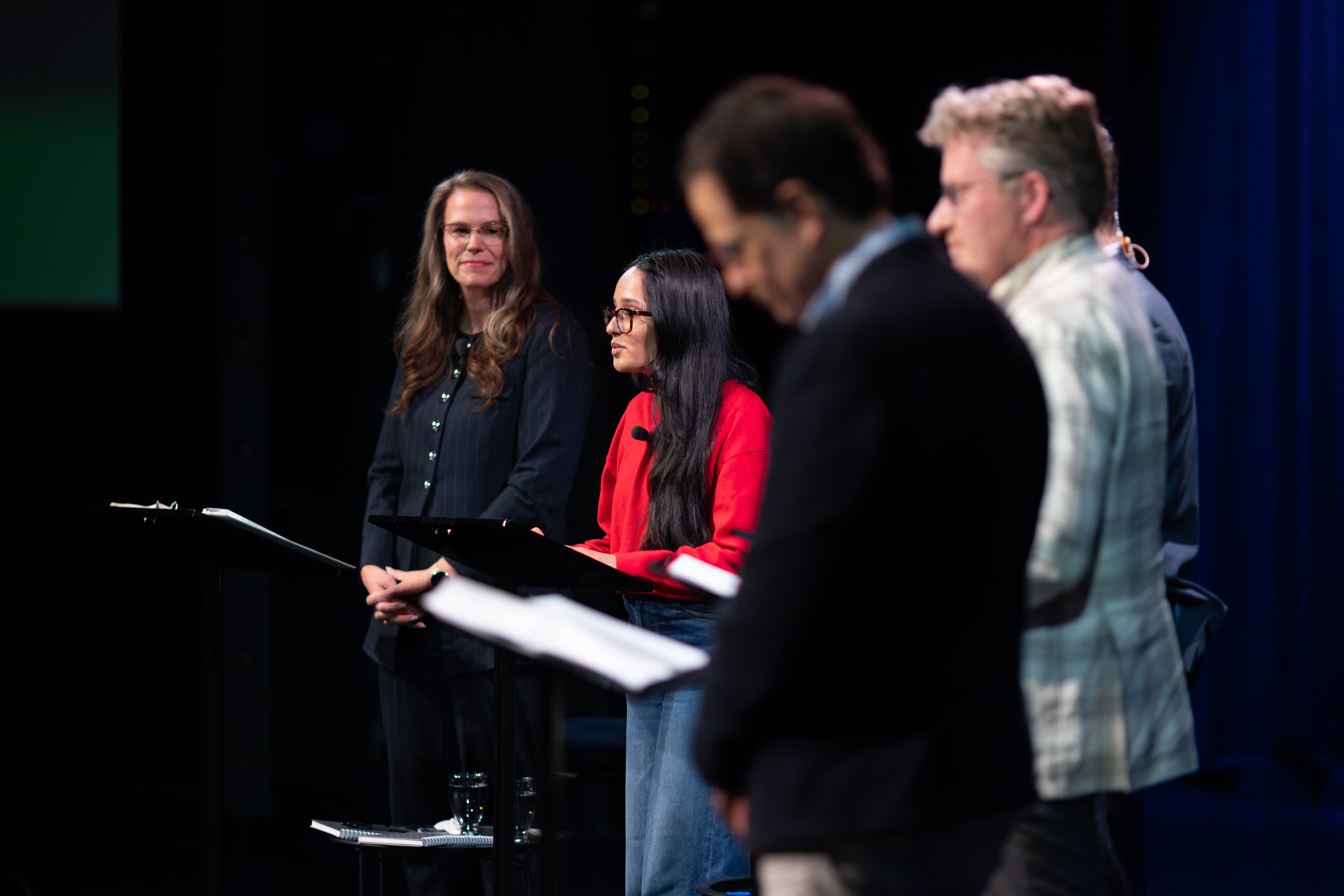
Shreya Saxena, a UBCO computer science graduate and entrepreneur, and Renée Merrifield, a founder and CEO of Troika and former MLA for Kelowna-Mission, were for the resolution. Dr. Paul Kershaw, an associate professor at the UBC School of Population and Public Health, and Mario Canseco, the president of Research Co., a polling and analysis firm, were against the resolution.
Saxena expressed gratitude for the generations before her who pledged to fight for their children, and argued that without their trailblazing, she wouldn’t have been afforded the opportunities she has today to build her professional career. She reassured that she couldn’t deny or sugarcoat the hurdles this generation faces, but she could say that today’s world is the best it has ever been. Merrifield reinforced Saxena’s statement, reminding the audience of Canada’s disturbing former track record with child mortality rates, life expectancy, and women’s rights, describing a world — inferior to the current one — nobody would want to go back to.
In contrast, Kershaw argued that life satisfaction among the younger generation has been plummeting, stating that it has become harder for the typical Canadian now to own a home, and noting an increasing reliance on inherited wealth to stay afloat. In an effort to not to place the blame on any individual, he instead touched on troubling governmental trends, which he argued were steadily leading Canada to a gerontocracy. Canseco also provided insight into issues plaguing young Canadians, which were mainly affordability and healthcare over broader issues like patriotism or environmental conservation.
Merrifield gave anecdotes as an employer at her company, and stressed that her AI usage promised efficiency and not employee replacement, stating: “We're looking at it as an augmentation. The only way to get more money into all of our employees' hands is to become more productive for every single employee.” Saxena, as a recent graduate herself, argued that the threat indeed loomed over anyone in search of work, but that AI’s introduction into the workforce creating a plethora of new roles in a variety of sectors was evidence that it was a net positive, ending with “I would rather inherit a bad market that’s opening up than a good one that’s closing.”
Kershaw countered, saying that technological advancements may not matter in the grand scheme of things when basic financial security is harder to achieve, and maintaining a good standard of living is becoming a burden. Canesco argued that homeownership remains a primary goal for the younger generation, regardless of how rapidly times are changing, including a greater tendency for the younger generation to pursue post-secondary education and move between cities.
Kershaw also disputed the age-old misconception that the younger generation would progress if it weren't for their materialistic values and frivolous spending habits, estimating that a young Canadian would need to sacrifice around thirteen lattes every day for five years to save a twenty percent down payment. He later sarcastically remarked, “That is so much latte.” Canesco also added: “They just want to continue to feel that there is light at the end of the tunnel.”
It was clear that beyond the panel’s differing viewpoints, they shared a mission as debaters to attempt to rationalize the younger generation’s frustrations with the current world. The four debaters reflected the different generations they focused on in their statements, as well as the audience, and it was what led them to acknowledge that these problems affect everybody, regardless of age.
At the end of the evening and the debaters’ closing statements, Skolski redirected the audience’s attention to one of the screens, which illuminated with the final Slido poll prompt, allowing the audience to answer: “Are you personally leaving a better world?” An overwhelming majority answered: “Yes, I am trying.”