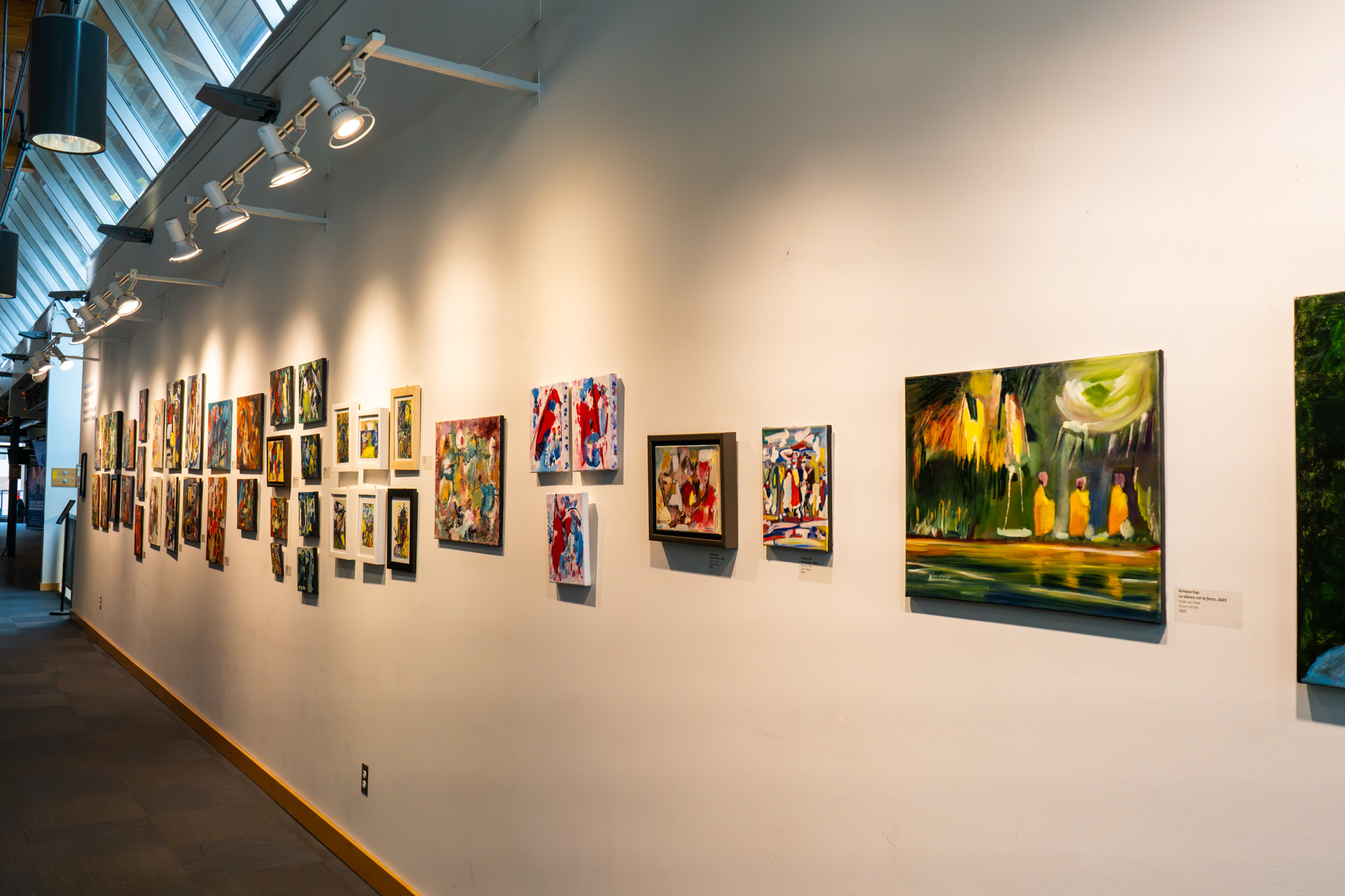
Art doesn't always happen when you are thinking about it. Sometimes, it just happens.
To Cambodian-born painter Kimpov Eap, painting is an instinctive effort between colours and movement, and the meaning may only reveal itself after the fact. The works of art in her La Nuit Transfigurée exhibit, which was part of the Nuit Blanche Kelowna festival at the Rotary Centre for the Arts, invite the audience to witness the process as a woman who has travelled from utter darkness and discovered new eyes to appreciate life.
The exhibition’s title, which translates roughly to “The Transfigured Night,” draws on the idea of metamorphosis. Curated by Professor Norman Cornett, the exhibition traces a movement from darkness towards light, reflecting both the emotional landscape of Eap’s paintings and the experiences that have shaped her life.
Asked what transfiguration means to her, Eap described nighttime as a space where dreams and sounds intermingle. Sometimes she feels frightened; at other times, she feels happy. In the dark, she thinks about her life and encounters something new. She described the possibility of moving beyond fear, waking to a new morning and having the freedom to do the things she loves.
That freedom is central to understanding her work.
Eap's canvases are dramatic abstract paintings, made vibrant with bursts of bright colour, but the process is not a calculated one. "When I paint, sometimes I do one or two colours, sometimes I do three, sometimes I don't do anything," Eap said, describing her technique. "I just feel."
Instead of working out a composition on paper, she lets instinct guide her hands. Maybe a certain colour calls to her, or certain lines and dabs of paint appear on the canvas, leading her somewhere she did not expect. Often, Eap doesn't even do a sketch. "I just feel," she repeated.
Music plays an important role in Eap's creative process as well. She listens to music while she paints, and has described, with characteristic matter-of-factness, that sometimes the energy gets into her and "the lines come, and the pictures come."
Cornett, who has worked with the artist for years, says Eap's instinctive approach is key to unlocking the universality of her paintings.
"She is, first and foremost, a visual expressionist rather than a verbal expressionist," said Cornett. "Her art transcends French, transcends English, and it is something that actually has a universality that knows no linguistic boundaries."
The words may elude her, but the expression flows. Eap's first language is Khmer, then French and English, and the interviewer had to switch back and forth trying to find the right word for the right moment. Her paintings, however, have a ubiquity that need not rely on language.
Sometimes, after finishing a painting, Eap is surprised at what she has done. Sometimes, a memory or experience not of her own making has lodged itself inside the artwork. As Cornett translated, Eap described looking at some finished works and said, "Ah, that's where I lived."
It is not exactly an easy life she has led prior to coming to Canada. She told the interviewer about growing up in Cambodia, about being stifled as a young woman and the freedoms she thought she would always have, until it was all taken away.
She married and had children, until the Khmer Rouge came. Her husband was taken in ’79 and never returned. She saw his belongings, discarded, on the street a week later. She had two children who died - one was six months old, the other, three. Describing how many people died in Cambodia during that period, she said, "How can you understand? It was like watching a movie or opera."
She finally escaped to Canada in 1980, and started anew, working in the restaurant business while studying, and painting. She remembers those days because she worked hard and was happy. "I like to go to school," she said. For years, she went to painting classes every Wednesday after work.
It is not entirely cathartic, Eap admits, to even talk about the pain. She doesn't always paint to remember, but it often gets remembered in the art. Cornett said that over the years, he learned more about Eap because of the conversations they had at her house, when paintings were not the subject. "One day, I was telling you about the days in the fields, when we had to dig the rice, with our hands, and the leeches," he said. "Another day, you told me about going out to try to find food for your daughters and you caught a snake with a little hook." Cornett said he wanted to share Eap's works as a local, and he wanted to see people get interested in the paintings. But it was more than an emotional tug at the heartstrings; it was something more. He was interested in exhibiting the works of Eap, who had, until then, been a largely unknown artist.
"She is quite passionate," Cornett said. "She is an expressive painter in her own right."
The paintings are not always easy to read, but the emotions run deep. "I don't know if she healed herself through painting," Cornett said. "But sometimes, I think, the painting came naturally. It wasn't that she wanted to paint this or that."
Cornett had first seen an Eap painting in a group show. He goes to lots of art shows as part of his duties as an art critic and curator, so the sight of a painting that, in the best way, stood out was not unfamiliar. "I spent about 10 minutes looking at it when Eap came to me and introduced herself as the artist," Cornett said.
Eap's home had more works, and he felt like he had found an artist of some significance, who deserved wider exposure. So he put out a call to a group show of her works and he invited experts from various fields to look at the paintings.
Cornett likes to work like this. Find artists, get them exposure, let the audiences discover their work. "We have to see art face to face," he said. "I think that's the whole point of art." The art world is not a kind place to those who do not know how to navigate it, Cornett said, adding that he has seen too many people get discouraged after their art is rejected. "When you see the real thing, it is something different than looking at your computer screen."
It would be nice to say the teamwork between Cornett, Eap and her husband Gaetan Sheridan made the magic happen, but that does not do justice to the process. Each has contributed in their own way to presenting La Nuit Transfigurée in Kelowna. Sheridan, an expert in the technical side of painting, has worked with Eap to prepare the works for their travels. Cornett has done the curating and made sure all the scholars weigh in. And Eap has, well, painted. In true collaborative spirit, they have worked to realise the vision rather than imposing it on the other. They had planned to lay out the paintings in such a way that the movement from night to light would be evident, but practicality dictated that they keep their options open since getting the paintings from Montreal to Kelowna without breaking them is a challenge in itself.
The title came about because both her and her husband love music, and Cornett suggested drawing an analogy to the famed Verklärte Nacht (Transfigured Night) by Arnold Schoenberg. Eap's practice includes Cambodian music, contemporary sounds and classical, each a different energy that feeds into her paintings.
For Cornett, the dichotomy between Eap's misery and her ability to find joy in the simple things in life is something that stays with him long after he has seen the paintings. "Ms. Eap has gone through some terrible times, and the darkest days," he said. "But when you actually meet her, what is going to strike you is her love of life."
That's the thing about art, Cornett says. It can be many things to many people. The joy in the little things, the feeling of discovery, the ability to move on despite hardship. But in Eap's paintings, all the things she has had to endure have been transformed in such a way that the audience is invited to see life still unfolding, full of possibilities.