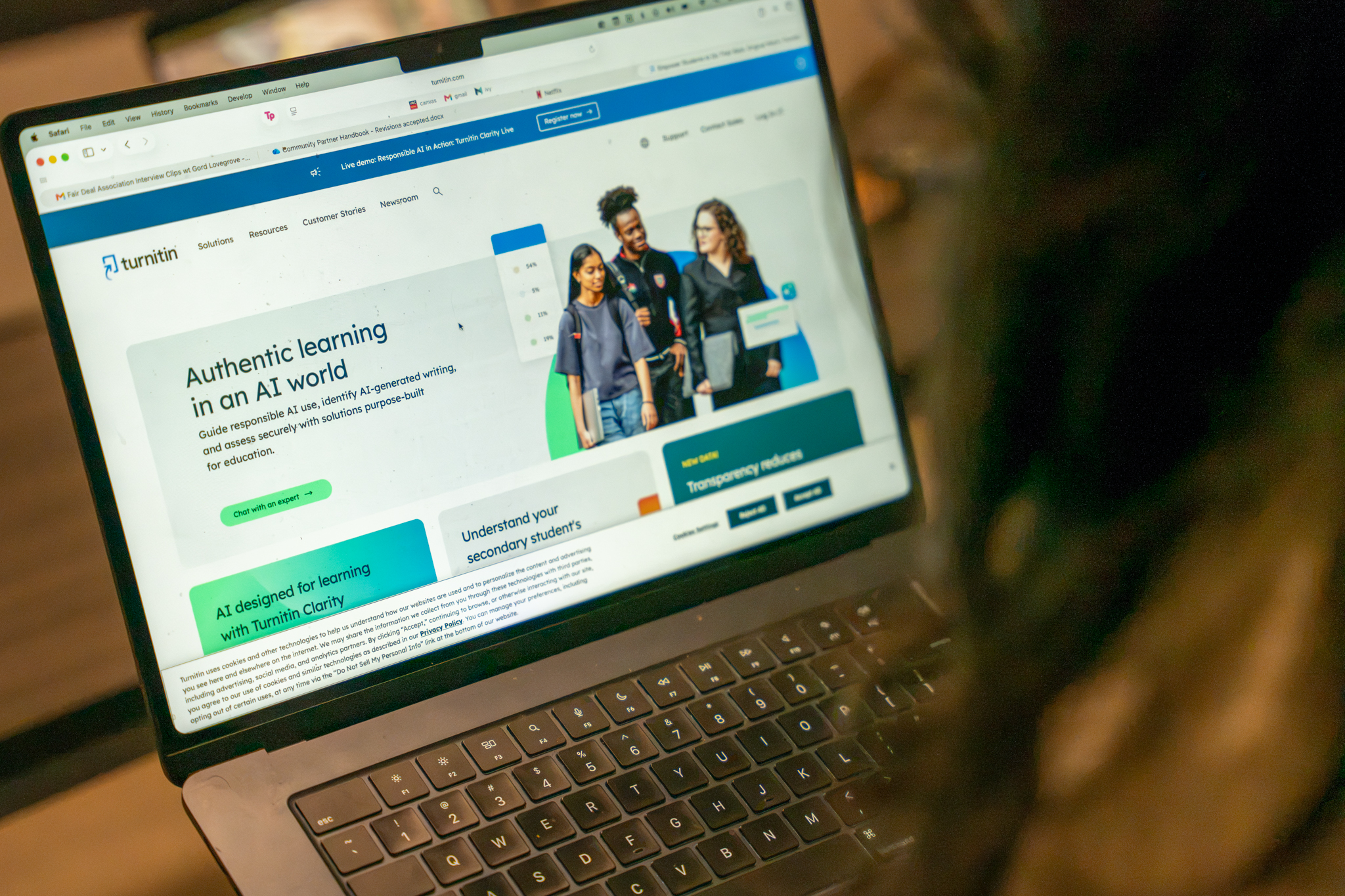
Turnitin is UBC’s primary plagiarism detection tool, and used widely in writing based courses in the arts, sciences, and engineering. Turnitin is trusted by over 15,000 universities, colleges, primary and secondary schools worldwide, reaching 34 million students in 1531 countries. UBC has supported the platform for a number of years, including a full integration with Canvas in 20242. As of recently, the well used plagiarism platform is under the heat.
Turnitin allows student submissions to be compared against a massive database of books, journals, online articles, webpages, and previous submissions. After submitting a paper through Canvas, the algorithm scours this database for matching text that indicates plagiarism. Text suspected of plagiarism is highlighted for review, for example if a quotation or citation is missing. The paper is given a percentage score based on the number and extent of plagiarized text detected.
As someone who has used Turnitin both as a student and teaching assistant, it is evident that the platform does not provide a completely accurate evaluation of plagiarism. Since it is purely based on text-matching, an authentically written paper could receive a high plagiarism score if common phrases are used. While it is a useful tool, it is important to verify exactly what was detected as plagiarism.
Turnitin aims to benefit both students and educators; students can check for accidental plagiarism before submitting a paper, and educators can verify submissions. The submissions are also checked against previous students' work for peer plagiarism, and Turnitin claims to have over 900 million student papers in their database1.
The world of academic integrity previously included plagiarism from oneself, a peer, or published sources. Now, there are concerns over students outsourcing their writing to AI.
Turnitin attempted to introduce an AI detector in 2023. The detector took advantage of the fact that AI generated writing is consistent while human writing is unpredictable3. Many universities, including UBC, rejected implementing this feature due to concerns about detection accuracy and lack of transparency.4
Turnitin offered a new approach after reflecting on the issues of AI detection. They proposed Turnitin Clarity, an embedded AI chatbot that monitors and assists student writing while providing educators with a clear indication of exactly how much AI was used in the writing.5
The feature would include a composition space for students in which they can access an AI chatbot. Instead of explicitly writing on the student’s behalf, the bot directs students to answer the question for themselves. For example, if a student asked for a written introduction, the bot might suggest the student considers the main idea and angle of the essay, then requests the student write a first draft which the bot can provide feedback on.
The chatbot records this interaction so that the educators can have more clarity on the paper’s AI usage. The feature can also flag suspicious activity, such as a large chunk of text being pasted into the document. Educators can adjust parameters of the chatbot, like its complexity, types of support, and level of assistance.
This sounds like a brilliant idea on paper; students use AI responsibly without completely outsourcing their work, and educators are aware of the extent of usage. The issues arise from how the chatbot is developed.
Turnitin announced changes to their licensing agreement that would allow student submissions to be used as AI training data. This provoked backlash from students, claiming that it is unfair for their original work to be used as training data without their consent.
As a student, there is no alternative to opt out of Turnitin, especially if it is embedded in Canvas like UBC. Students must face difficulties submitting outside of Canvas or losing marks if they wish to not support the feature.
Protests that began at the student and student union level eventually incited real change from universities. The University of Cambridge was the first institution to refuse to sign Turnitin’s new contract6. The University of Southampton announced a termination of their agreement with Turnitin, and that they are beginning to introduce alternative tools.
“We have a responsibility to protect the data, intellectual property and academic work of both our students and the University.7”
Turnitin did not provide a conclusive response, and instead postponed changes to the licensing agreement until September 2027. So far, UBC has not published a statement on the situation. The dilemma raises a question of who gets to decide ownership of intellectual property. Should students be able to decide what happens with their original work, or should the decision fall on university?
The fate of this decision could be quietly made by Turnitin, but it is the loud voices of students that are responsible for keeping the fight alive.