Life on Earth is remarkable; us humans are able to solve problems, build machines, write poetry, cure diseases, and love one another. The interactions in our brains translate to intense feelings of wonder, joy, rage, and grief. We live on a planet rich with a diverse range of plants and animals. Even the simplest bacteria cells conduct chemical reactions to convert energy and transmit genetic information.
When I look up at the universe, I am struck by both the beauty and emptiness of its magnitude. Septillions of planets are out there, yet none seem to be blessed with this miracle of life. Is this level of complexity unique to Earth?
Scientists have spent lifetimes searching for an answer, for even a sliver of hope that we are not alone. Probes collect direct samples from Jupiter and Saturn’s moons in the chance that other life could exist in our neighbourhood. The Perseverance rover studies the surface of Mars for signs of ancient microbial life.
Looking further away than the solar system makes things trickier. Telescopes analyze different types of light in hopes to find radio or laser signals that could only be artificially made. Certain telescopes can image planets and isolate the types of light that they reflect, known as spectra. Scientists understand how many molecules reflect light, and so using these images they can determine what molecules exist in a planet’s atmosphere light-years away.
An element or molecule that provides evidence of life is known as a biosignature. Think of finding footprints in the snow. Even without seeing who left them, you can infer someone has walked by. In the same way, the existence of certain molecules on a planet indicate life.
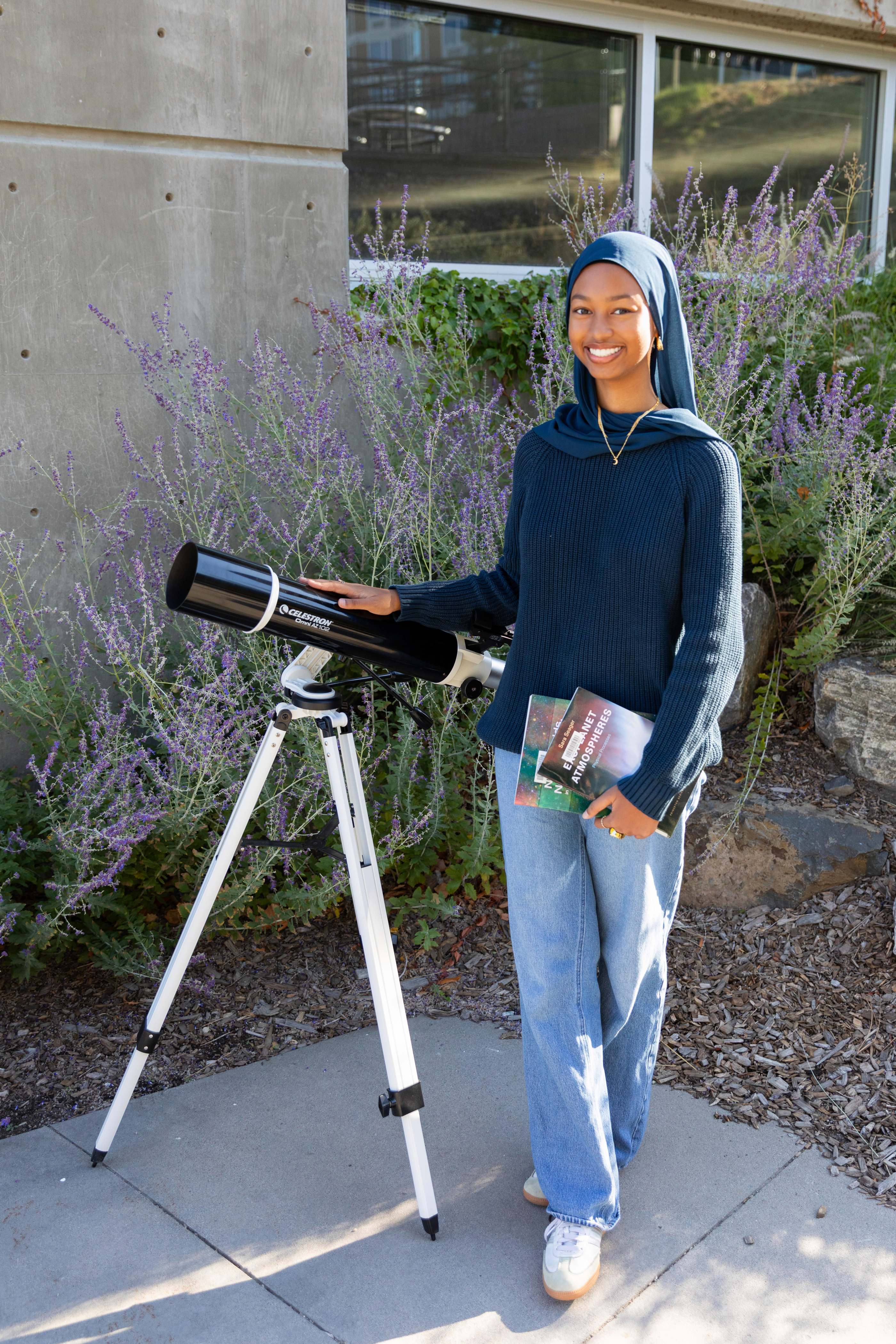
UBC Okanagan’s Nano Science Laboratory, under the leadership of Dr Robert Szilagyi, aims to use computational chemistry in classifying biosignatures. The project is led by student researcher Nadifa Omar, who specifically researches sulfur as a possible biosignature.
The project was inspired from a discovery of sulfur molecules detected in the atmosphere of K2-18b, a planet located 124 light-years away. On Earth, these molecules are only produced from the biological processes of plant and marine life. Omar considers the possibility that the sulfur molecules could come from a nonbiological origin on K2-18b.
“I created a model of what the spectra of the planet would look like if the sulfur came from non-biological origins, and compared it with data from the James Webb Space Telescope.”
There are five main potential non-biological origins of the sulfur molecules detected. Omar’s research ruled out one of those pathways, significantly increasing the likelihood that K2-18b’s sulfur originated from life.
The discovery of biology on K2-18b would be a monumental feat for all of humanity. It would mean that we are not alone. It would imply that Earth is not a miracle, but instead life is a consequence of planetary physics and time.
It should be noted that if life exists on K2-18b, it is most likely nonintelligent simple organisms like bacteria or algae. However, discovering such life would drastically increase the chances of intelligent life elsewhere in the universe. After all, Earth’s biodiversity and intelligence would not be possible without the single-celled organisms that ruled the planet for three billion years.
“I would frame looking at life beyond Earth as one of humanity’s biggest questions; Earth is so unique and it’s an inherent characteristic in humans to want to find somebody who we could communicate with.”
Perhaps one of the most remarkable aspects of Omar’s research is that she started it at only sixteen years old. Growing up participating in science fairs and reading NASA articles inspired her to reach out to local UBC Okanagan professors. She was especially intrigued by Dr Szilagyi’s computational chemistry work because it was more concrete and experimental than pure theoretical math.
“Starting research early on gave me the opportunity to make a lot of mistakes and learn from them. I think research is such a beautiful thing.”
At the 2026 Canada-Wide Science Fair, Omar was awarded the Gold Excellence Award and the CAP Physics Prize from the Canadian Association of Physicists. The project received the third place prize at UBC Okanagan’s 2025 Undergraduate Chemistry and Biology Symposium.
Omar began a degree in math and physics at Columbia University in September 2026, and she hopes to continue looking for life beyond Earth.
In what may be humanity’s greatest search, we hope to one day find conclusive evidence of life somewhere in the universe. Doing so may ultimately help us better understand our place in the universe.