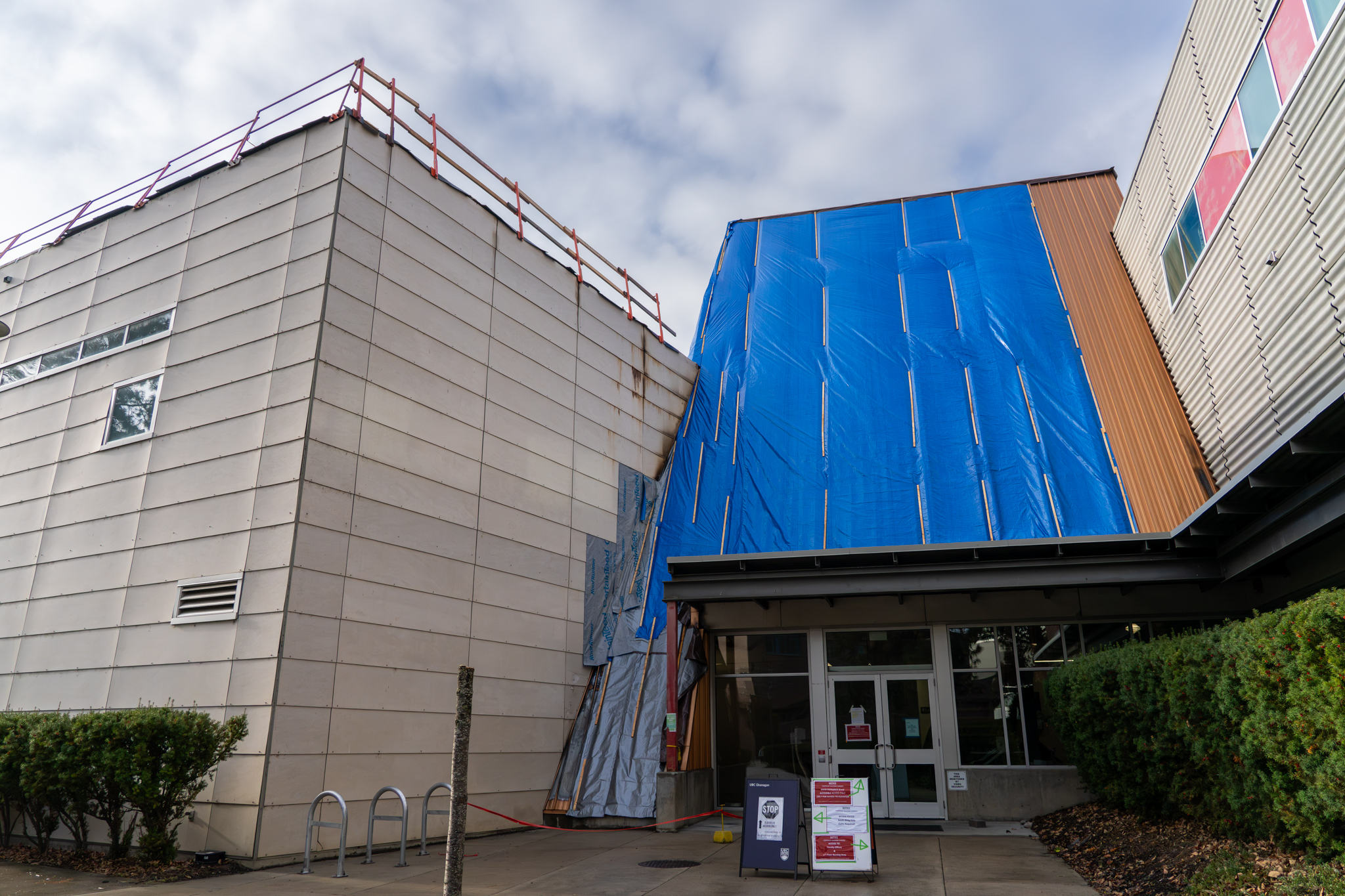
On October 29, 2026, around 12:30 PM, the roof of the Creative and Critical Studies (CCS) building caught fire. Everyone evacuated the building safely, and firefighters responded swiftly.
According to reporting by Castanet, the cause of the fire was construction work that ignited spray foam insulation behind the building’s steel cladding, creating the perfect conditions for the fire to spread rapidly across the building’s roof. Although no injuries were reported, there was smoke and water damage, as well as physical damage from the firefighters needing to enter the building to put the fire out. This prompted the building’s two-week closure.
On November 16, the building reopened for students, except for rooms 221, 222 and rooms on the third floor, and alternate entry points were created for specific areas of the building.
English professor and dean of the Faculty of Creative and Critical Studies Bryce Traister, whose office is located in the CCS building, recounted his experience on the day of the fire, explaining that it was: “Unnerving for the entire community, how quickly it spread and became an emergency.” However, he also said that the administration staff were trained for these kinds of procedures and evacuation musters, and by his account, the building was evacuated in less than ten minutes. Traister ended by saying: “The emergency phase has since been supportive, listening to our concerns.”
Traister also mentioned what was communicated to him and the broader community after the initial fire: “On November 2nd, we were alerted that three things needed to happen: byproducts don't pose a health concern, if the building responded, we would be able to maintain emergency health requirements, [and] safety systems/fire panel were working.” He continued: “ On November 13th, we were told the building would be partially reopened starting this week. Communication was excellent; totally reasonable what needed to happen.”
When asked about alternative spaces which were arranged, Traister began by saying he thought they would have to follow COVID-19 protocol, even though it would be hard to put the arts program online, and there was a real fear that the building would remain closed for the remainder of the term. However, he highlighted the response from his colleagues and the community, stating: “Within hours I was getting emails for hanging spaces, meeting spaces, that has continued for the duration of the closure, [and] classroom spaces arranged by the library.” He also mentioned that he was: “Holding office hours at Starbucks.”
Luckily, the building’s reopening process began sooner than expected. Traister stated: “The state of the building became more clear; damage had been minimal, we weren't facing the kind of loss that we were fearing.”
Much of the visual arts program relies on the teaching studios located inside the building, and Traister emphasized that these programs specifically would have been harder to shift online and find alternative arrangements for. Many students and faculty were afraid that they would lose their materials and projects, so the fire and the closure were a stressful period.
Shawn Serfas, an associate professor of visual art and the department’s head, expanded on the challenges that instructors and students faced during the building’s closure, stating: “The biggest challenge was finding suitable spaces for courses that rely on hands-on learning, specialized equipment, and studio environments. Instructors had to be flexible and creative in adapting their teaching methods and relocating classes.” He also mentioned that some classes had to be cancelled the following week of the fire.
As many students were not able to immediately resume their classes, attend exams or critiques, or hand in assignments, Serfas described how the faculty and campus community were able to accommodate those students by devising practical solutions. He said: “This included adjusting project deadlines, modifying course expectations, finding alternative workspaces, and maintaining communication with students.” He also added the role of other departments and faculties outside of the Faculty of Creative Studies, continuing: “Other departments and campus facilities helped accommodate relocated classes and activities.”
The university set up a process for people to pick up their materials with an escort, and those affected were able to specify what they needed picked up through a Qualtrics survey. Considering that many students had ongoing projects that they spent a lot of time working on, there was also a strong sense of urgency for the CCS building to reopen soon during its closure. On this, Serfas said: “Understandably, many students were concerned about artwork and projects they had spent considerable time developing.” However, he also stated that he “did not receive any reports of damaged artwork.”
For example, one student via an Instagram DM shared that their ongoing Linoleum printing project, an assignment part of an advanced printmaking course, as well as another displayed in the gallery, were still in the building during the fire. While students were able to request entry to obtain personal items, there was, at the time, no access to the print studio where the student’s project was left.
The fire was a scary experience for the campus, especially considering what was at stake. Nobody knew what would come of it or how long the building would be closed for. Despite this, the UBCO community showed immediate support and resilience, with emergency services, campus operations, faculty, staff, and students coming together during an uncertain time, which served as a learning experience for the community.